
White-Label Shopify Development: How It Works for US Agencies
How white-label Shopify development works for US agencies: the process, 2026 costs, protecting your client relationship and choosing the right partner.
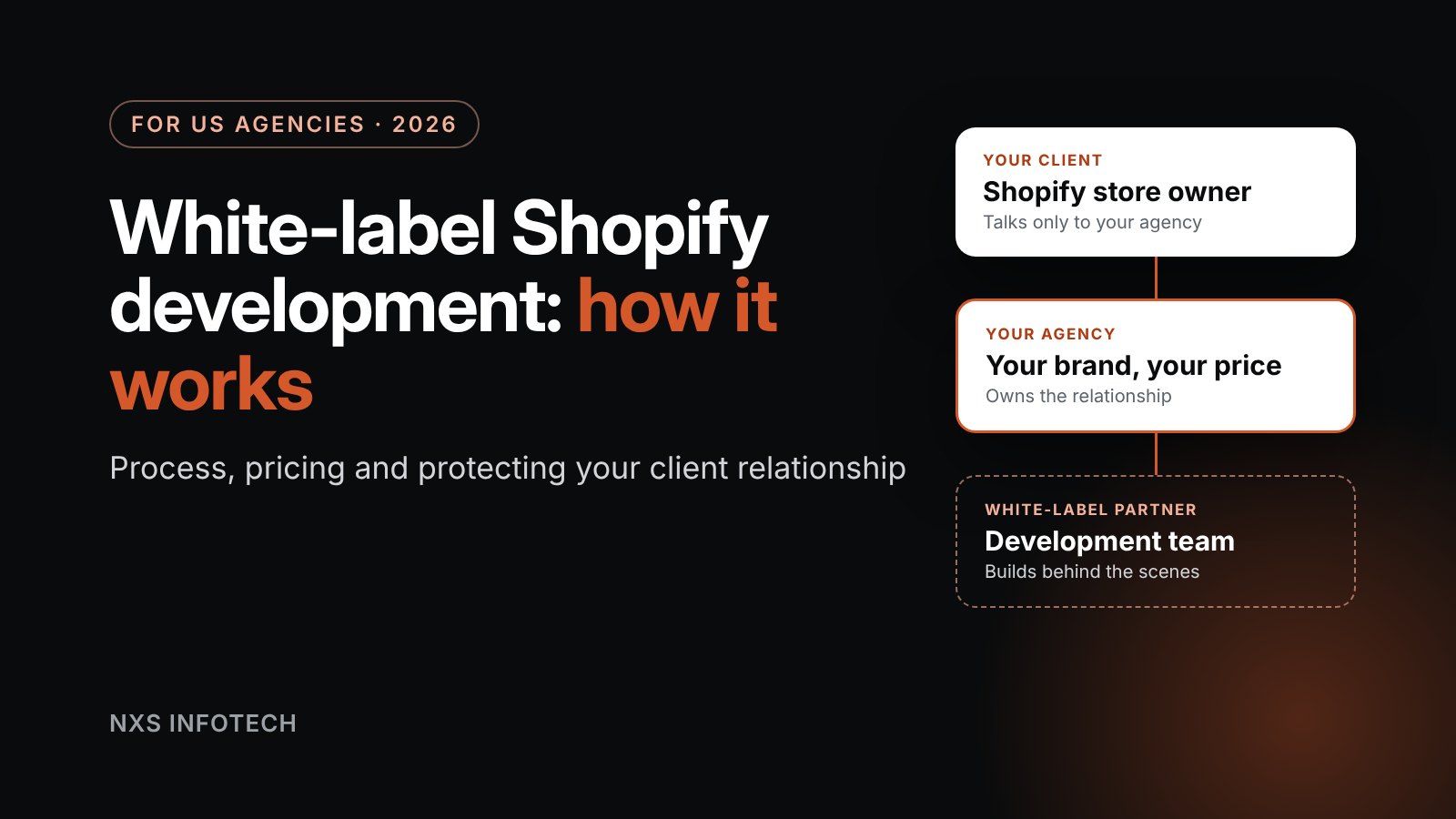
Your agency sold a Shopify redesign, a migration or a monthly support retainer. Now someone has to do the work, and your in-house developers are already booked. White-label Shopify development lets you deliver that work under your own brand, at a cost that leaves room for a healthy margin.
This guide explains how white-label Shopify development works for US agencies: the process, what it costs in 2026, how to protect your client relationship, and how to choose a partner you can trust with your clients’ stores.
What is white-label Shopify development?
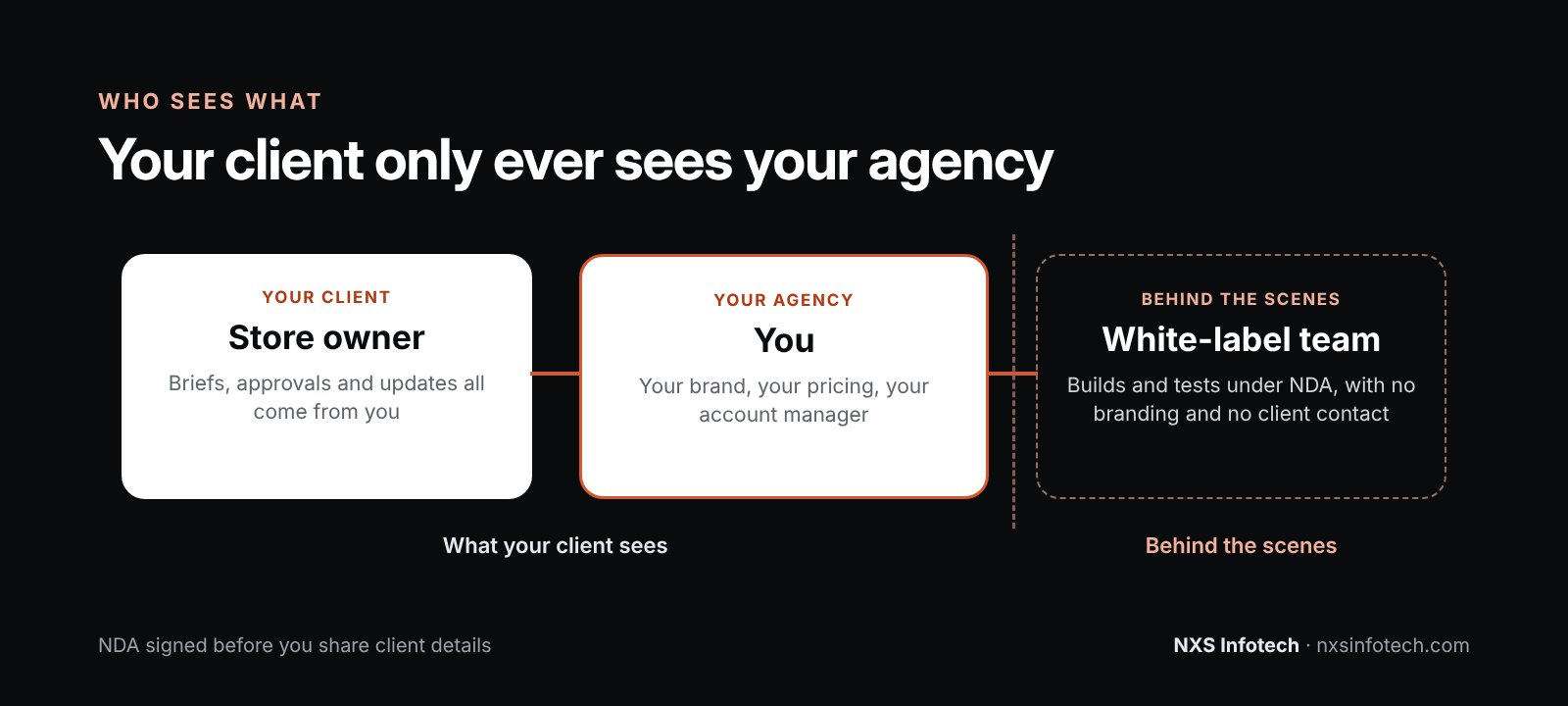
White-label Shopify development means a partner team builds and maintains Shopify stores for your clients, while your agency presents the work as its own. Your client briefs you, approves the work with you and pays you. The partner works behind the scenes, with no branding and no direct contact with your client.
It differs from simply hiring a freelancer for one job. A white-label partner works inside your process and tools, follows your standards, and covers the whole range of Shopify work your agency sells, from theme builds to monthly store support.
When white-label makes sense (and when it doesn’t)
White-label Shopify development works best when your agency sells more Shopify work than your team can build, when demand comes in waves, or when you want to offer Shopify without hiring a full-time developer. It’s also a good fit for ongoing support retainers, where steady, predictable tasks are easy to hand off.
It’s a weaker fit when a project is mostly strategy and constant client workshops, or when your client contract requires every person who touches the store to be on your payroll. In those cases, keep the work in-house or agree on a model where the partner joins calls openly as part of your team.
How white-label Shopify development works
A good white-label workflow is simple enough that your account managers can use it without a manual:
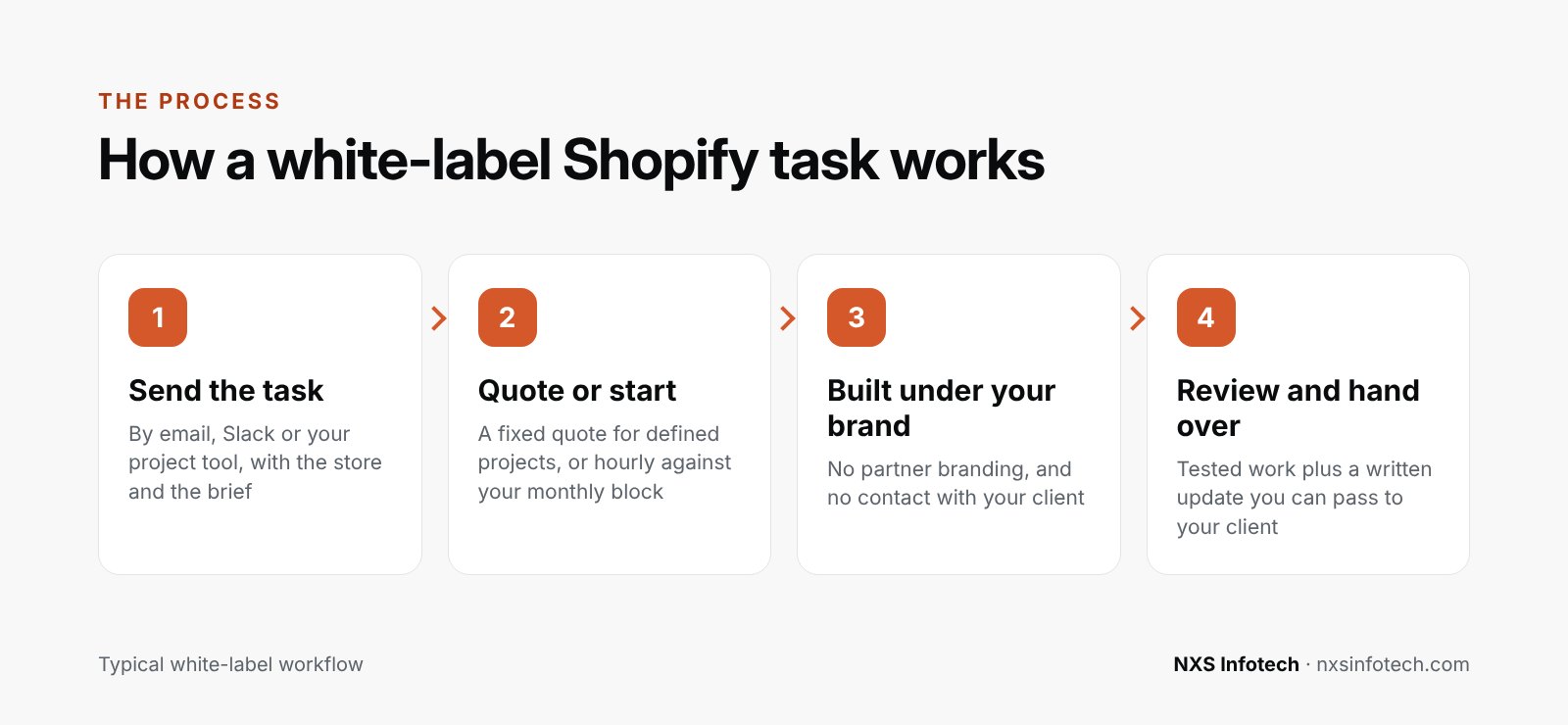
- Send the task. Share the store, the brief and any designs by email, Slack or your project management tool.
- Quote or start. Defined projects such as a theme build or migration get a fixed quote. Smaller requests are worked hourly against a monthly block.
- Built under your brand. The work is done in your client’s store or a development store, with no partner branding anywhere.
- Review and hand over. Every task is tested and comes with a written update you can forward to your client or rewrite in your own voice.
For store access, Shopify’s collaborator accounts let a partner request access to a client’s store with only the permissions you approve, so you never need to share the owner’s login.
What US agencies outsource most
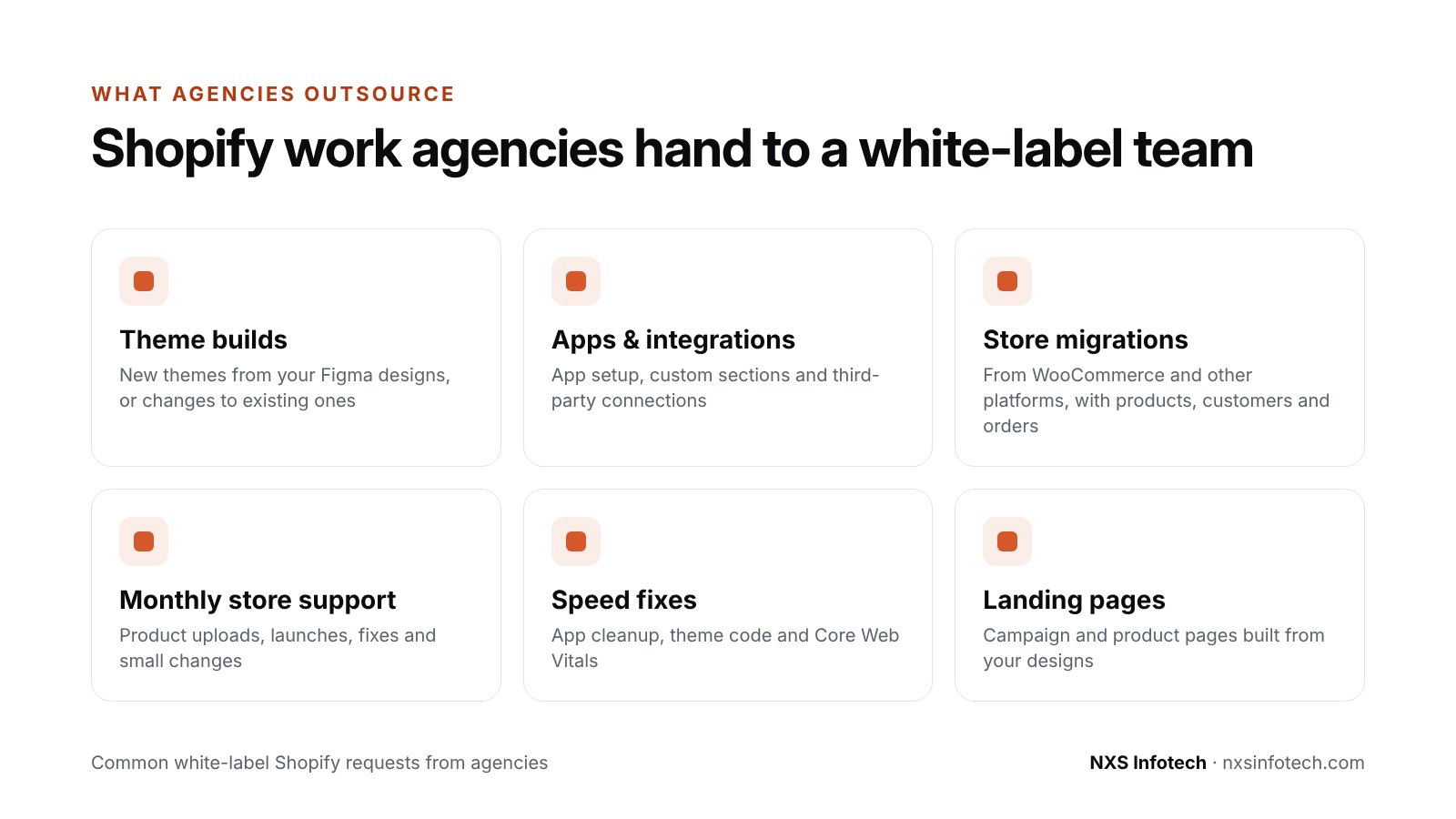
- Theme builds and customization: new Online Store 2.0 themes from your Figma designs, or changes to an existing theme.
- Apps and integrations: app setup, custom sections and connections to email, reviews, shipping or ERP tools.
- Store migrations: moving clients from WooCommerce and other platforms with products, customers, orders and redirects.
- Monthly store support: product uploads, seasonal launches, fixes and small design changes.
- Speed fixes: removing unused app code, slimming theme files and improving Core Web Vitals.
- Landing pages: campaign and product pages built from your designs.
Many agencies keep strategy, design and client communication in-house and outsource the build and ongoing development. That keeps your team focused on the work clients value most.
What white-label Shopify development costs in 2026
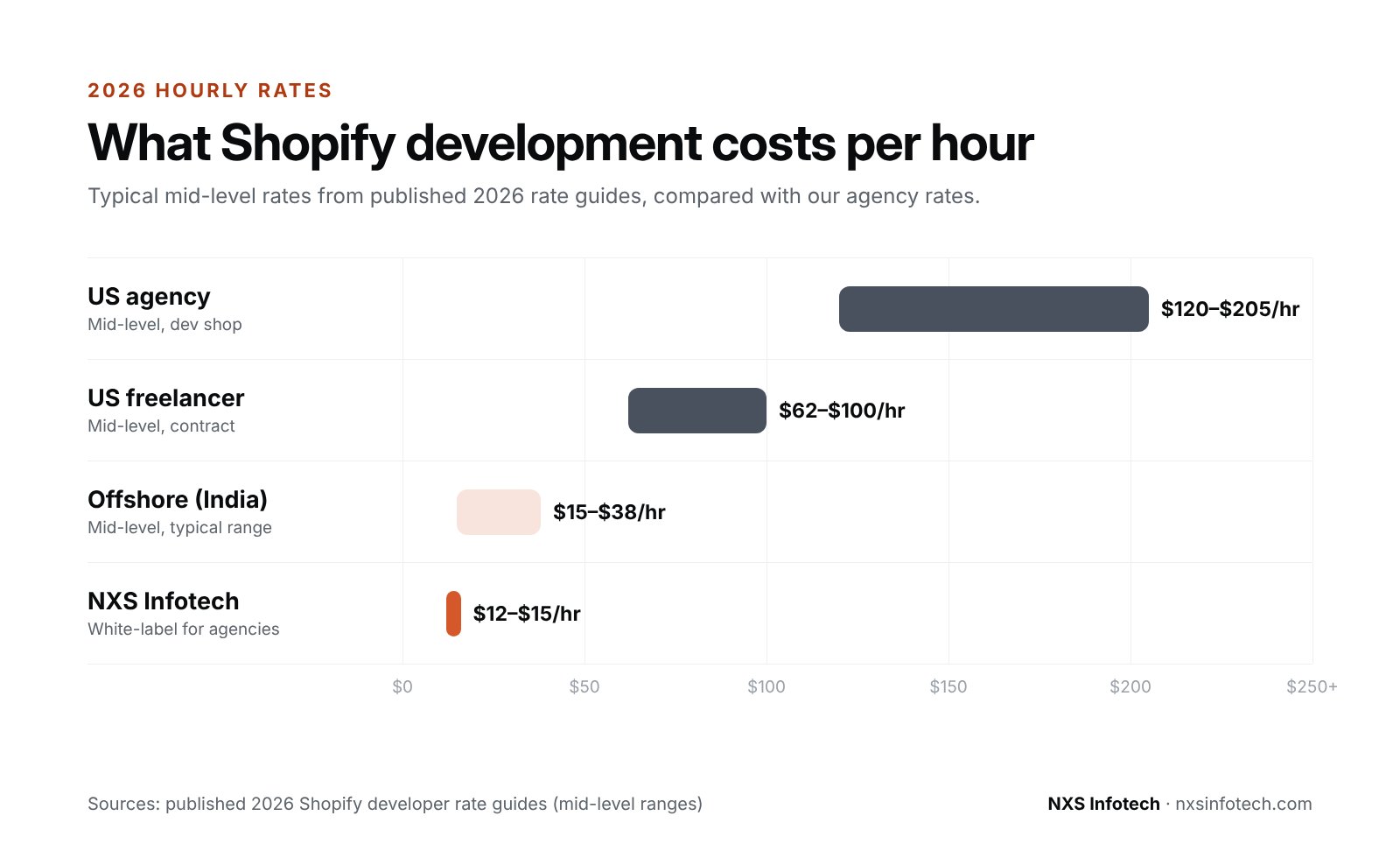
Published 2026 rate guides put mid-level Shopify development at very different prices depending on who does the work:
| Who does the work | Typical mid-level rate (2026) |
|---|---|
| US agency or dev shop | $120–$205/hour |
| US freelancer | $62–$100/hour |
| Offshore team (India) | $15–$38/hour |
The gap between what your client pays your agency and what the development costs you is your margin. With a US agency rate of $120 or more per hour on the client side and an offshore white-label cost in the teens or low twenties, agencies can price competitively and still keep most of the difference.
Watch for the hidden costs, too: project management time, revisions caused by unclear briefs, and work that has to be redone. A cheaper hourly rate isn’t cheaper if your team spends hours fixing the output.
How to protect your client relationship
- Sign an NDA first. Before you share client names, store data or designs, get an NDA in place.
- No partner branding. No credits in the theme, no partner names in commit messages, store notes or emails.
- No direct client contact. The partner should only speak to your client if you invite them to a call as part of your team.
- Limited store access. Use collaborator or staff accounts with only the permissions needed, and remove them when the work is done.
- You own the deliverables. Make sure your agreement says the code and designs belong to you and your client.
Making time zones work for you
A team in India working through the evening in US time can turn time zones into an advantage. Tasks your account manager sends at the end of the day are often finished by the next morning, ready for review before your client starts asking. Look for a partner whose working hours overlap with your mornings, so urgent questions don’t wait a full day.
Common mistakes when outsourcing Shopify work
- Vague briefs. “Make the product page better” leads to rework. Share designs, examples and acceptance criteria.
- Skipping a development store or theme copy. Changes should be built on a duplicate theme and published only after review.
- No single point of contact. Messages scattered across email, Slack and comments get missed. Agree on one channel per project.
- Starting with your biggest client. Test a new partner on a small paid task before handing over a major store.
- Not tracking hours. Ask for tracked, reported hours so you can bill your client accurately and protect your margin.
How to choose a white-label Shopify partner
- Proof of Shopify work: live stores they run or built, not just a portfolio of screenshots.
- Agency experience: partners who already work with agencies understand briefs, deadlines and invisible delivery.
- A team, not one person: developers, designers and QA, with cover when someone is away.
- Clear pricing: hourly, monthly blocks or a dedicated developer, with tracked hours and no long contracts.
- Written updates: a short report on every task, so you always know what changed.
- A small paid trial: the fastest way to judge speed, communication and code quality before committing.
How white-label Shopify development works with us
We’ve been the behind-the-scenes development team for agencies since 2016, and we’re Top Rated Plus on Upwork with 100% Job Success. We run Shopify stores day to day, including MexMax with 2,600+ products. Agencies work with us in three ways:
| Plan | Price | Best for |
|---|---|---|
| Pay as you go | $15/hour, no minimum | Occasional tasks and trying us out |
| Monthly block | $600/month for 40 hours ($15/hour) | Agencies with steady Shopify work |
| Dedicated developer | $2,400/month for 160 hours ($15/hour) | A full-time developer inside your team |
There are no setup fees or long contracts, we sign an NDA before you share client details, and we work in your tools: Slack, Asana, Trello, Basecamp, ClickUp or email. See our white-label development for agencies or our Shopify development services to learn more.
FAQ

Written by
Keyur Patel is co-founder and director of NXS Infotech, where he leads client partnerships. Since 2016 he has helped US e-commerce brands and agencies plan and grow their stores, from Shopify builds and marketplace management to SEO, email and paid ads. He has kept the agency Top Rated Plus on Upwork with a 100% Job Success Score.
Need Help With Your Website?
Book a free 20-minute call. We’ll review your site and tell you honestly what to fix first.
Free 20-minute call
Talk to a Founder About Your Store or Site
No sales pitch. You leave with a short list of what to fix first, even if you never hire us.